 Ọmọ Oòduà Naija Gist | News From Nigeria | Entertainment gist Nigeria|Networking|News.. Visit for Nigeria breaking news , Nigerian Movies , Naija music , Jobs In Nigeria , Naija News , Nollywood, Gist and more

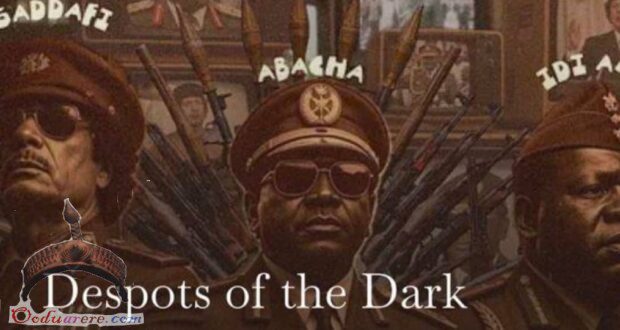
“He may be a son of a bitch, but he’s our son of a bitch.”
- U.S. President Franklin Delano Roosevelt (FDR).
This is the single unbroken rule of Western engagement with African leadership.
This principle applies as much to African heads of state as it does to the powers that back them. Steal for the West, and you become an “astute politician.” Steal from them, or worse, steal for your country, and you become a monster in need of removal.
Perhaps looking at history from a non-Anglo perspective cleans up the scratches on its lens, making reality much simpler yet complex, allowing us to revisit the myth of Amin, Abacha, and Gaddafi through the looking glass of time. They were men who believed their countries should not be permanent economic colonies, who acted on that belief, and who were destroyed by a machinery of narrative control so sophisticated it could turn debt repayment into theft and social programs into tyranny.
This is not a defense of these flawed leaders; after all, they are humans. It is a reclamation of context from those who weaponize it selectively. We have seen Sani Abacha pay down Nigeria’s debt and earn sanctions and the word “kleptocrat” for his trouble and seen Muammar Gaddafi build social programs that would embarrass Scandinavia and die sodomized in a ditch on the streets of Libya. Libya’s literacy rate rose from around 10–25 percent before his rule to over 80–90 percent by the 2000s, supported by free education, free healthcare, and extensive welfare programs that gave Libya one of the highest human development indicators in Africa.
In this article, we move through Idi Amin, Sani Abacha, and Muammar Gaddafi as case studies of how sovereignty is turned into “despotism” on Western screens; explore the architecture that makes it work; and finally, we return to the question of African sovereignty and who gets to tell the story of these so‑called “monsters.”
The West does not fear African “cruelty”; it fears African sovereignty. This is an examination of the three men who said no and the propaganda machine that turned their defiance into monstrosity.
On Idi Amin
The West’s belief in its control over the dark continent is rooted in racism and supremacy: the idea that the people of the continent are, in fact, backwards and have limited cognitive abilities that require management. This method was also applied to Idi Amin.
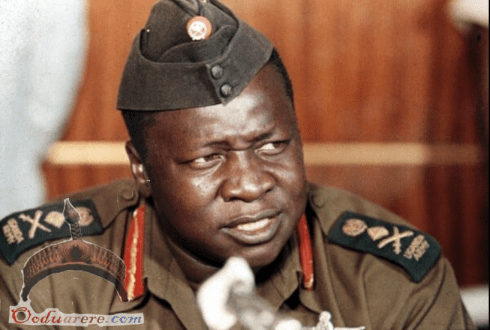
Amin didn’t emerge from nowhere. He was Britain’s man in Uganda, cultivated through the King’s African Rifles as one of two natives in the unit, where his considerable physical strength and apparent loyalty made him useful. The British trained him, promoted him, and when they needed someone to help unseat another of their beloved tyrants, Milton Obote, in 1966, they turned to Amin. For years, Amin was their enthusiastic enforcer, who eliminated the threats they became bored with or acted as their personal arms dealer to destabilizing forces in the Horn of Africa: their “uncoordinated and overenthusiastic” asset who could be counted on to do the necessary violence while remaining plausibly deniable.
Then he expelled the country’s entire Asian population, giving them just 90 days to leave. He also conducted the purge of white economic leverage, land ownership, and political presence in Uganda. Then he invested in Uganda’s physical infrastructure, including roads, hospitals, and schools, and gave opportunities to indigenous Ugandans to manage government positions previously held by colonial governors, emphasizing what he termed “economic liberation” from colonial structures. Overnight, he transformed from “strongman” to “savage cannibal.” How convenient.
I mean, the guy was also insane. In 1976, he proclaimed himself “King of Scotland” and offered to free Scotland from oppression. He even created a Scottish band, sending men to Scotland to learn bagpipes. He played Scottish music for visiting dignitaries, offered to liberate Scotland from British rule, and wore a kilt to a Saudi royal funeral.
Like any other power-hungry leader confronting the entire Western pole, he exhibited extreme paranoia. But the insane rhetoric of him being a cannibal and steeped in the brutal African village idiot or “mentally unbalanced” “madman” trope doesn’t leave room for multidimensional humanization or the million-dollar word: CONTEXT!
On Sani Abacha
Sani Abacha did not fall from the sky as a cartoon villain whose demise was sealed at the bite of a poisoned apple. He emerged from a military and political ecosystem shaped by postcolonial chaos and Western economic chokeholds.
Abacha’s reign brought a significant increase in oil revenue for the country’s economy while paying off the country’s debt. Abacha’s administration oversaw an increase in the country’s foreign exchange reserves from $494 million in 1993 to $9.6 billion by mid-1997, and reduced Nigeria’s external debt from $36 billion in 1993 to $27 billion by 1997.
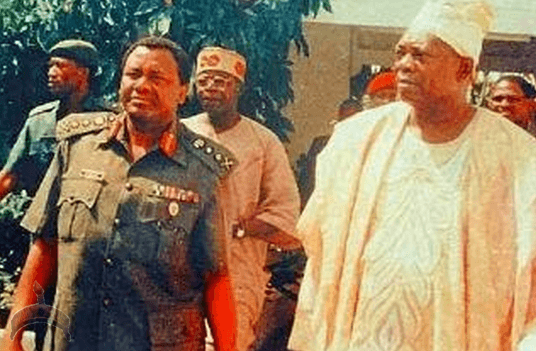
The perpetual economic independence of Nigeria from Western hands was a big no-no. The situation led to sanctions against the country due to the infamous “human rights violation” trope wielded by the Western administration.
These sanctions led to the movement of sovereign funds, or as the West has propagandized, “loot,” through alternative channels. This scenario can be compared to the movement of the Russian or Iranian economic framework in order to circumvent US sanctions on the aforementioned countries.
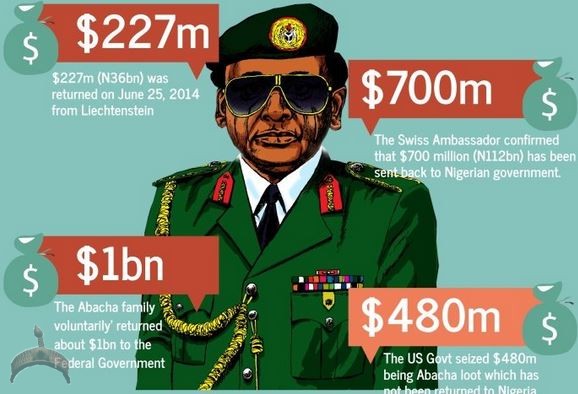
According to the narrative, Abacha and his circle undeniably stole and stashed funds abroad. Following that narrative: didn’t those funds pass through Western and offshore banks, into bonds and financial instruments in London, New York, and Zurich? Didn’t financial institutions take their fees before returning a fraction decades later under “asset recovery”? Didn’t these agreements often come with conditions on how Nigeria could spend its own money?
The West labels these redirected sovereign funds as “loot,” largely because they are funneled through complex financial pipelines designed to evade sanctions. This approach is not unique; it reflects a broader tactic used by several countries facing international restrictions, including Russia, Iran, and Venezuela. These nations have adapted their financial systems to move resources covertly to circumvent Western hegemonic control over their economy.
This is not to cast Abacha as the 90s Nigerian male version of Mother Teresa, at least before we found out that she was no saint at all. He was, in fact, a paranoid, no-nonsense leader who contained dissent in order to realize his vision for Nigeria. Hey, we all have our own mental illness hurdles to grapple with. But also, corruption is not a phenomenon that plagues Africa alone. It is not a spiritual curse that descends at the Equator. It is a global language spoken in different accents: “pay to play,” “campaign finance,” “defense contracts,” and “consulting fees.” The only real difference is PR and branding. In the West, theft is laundered through institutions; in Africa, it is pathologized as proof that Black people are inherently unfit to govern themselves.
It is no surprise that at the death of Abacha, his successor Abdulsalami Abubakar immediately returned the country to IMF debt. The perpetual economic interdependence introduced then continues to this day. The current Western-backed government, upon receiving the “loot” of Abacha from the Swiss, immediately gobbled it up, and it did not and will never go to the Nigerian people.
The point is that the ultra-demonization of his legacy and presidency was merged with Western propaganda due to his non-cooperation with their economic rip-off plan for Nigeria, even as the same institutions that denounced him had already profited from holding, managing, and then “repatriating” his so-called loot.
Unsurprisingly, his life came to an unexpected end with speculation that he was poisoned by the CIA and/or Mossad, given he died of a “heart attack” His Former Chief Security Officer Major Hamza Al-Mustapha stated that Abacha’s health suddenly collapsed on June 7, 1998, at the Abuja International Airport, immediately after one of the security operatives who accompanied President Yasser Arafat shook hands with him after meeting.
You might argue that the CIA and/or Mossad, (let’s be honest, they are essentially the same entity) had no involvement in his death, but it’s also worth noting that Abacha’s socialist rival, MKO Abiola, who also believed in the sovereignty of the Nigerian economy and society, unexpectedly died on July 7, 1998, the same day the government would be release Abiola, Susan Rice and Ambassador Thomas Pickering led a US delegation to visit Abiola. Abiola suffered a fatal heart attack during the meeting; according to the Punch, the American delegation met him at 3 p.m., and he died between 3:20 and 3:40 p.m. At some point, pathology starts to look like policy.
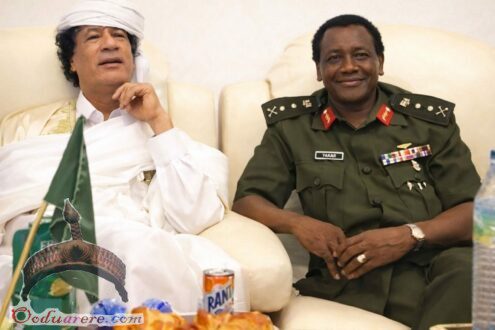
Muammar Gaddafi visiting Sani Abacha in Kano, Nigeria, in May 1997.
On Muammar Gaddafi
Gaddafi, the neurotic, stylish president of Libya, has been referred to as Abacha’s twin in the sense that they valued economic independence and sovereign countries free from imperialist manipulation.
Gaddafi’s Empire Of Tuna Fish And Hotels In Uganda
The Gold Dinar represented an existential threat, not because Libya alone could unseat the dollar, but because Gaddafi was actively recruiting other African nations to join. A declassified email from Sidney Blumenthal to Hillary Clinton, dated April 2, 2011, states that Gaddafi’s government held 143 tons of gold intended to establish a pan-African currency based on the Libyan golden Dinar, designed to provide Francophone Africa with an alternative to the CFA franc. A challenge that now echoes in the current Sahel governments’ moves to exit CFA‑based monetary colonialism and build their own common currency. The CFA franc reign is coming to an end due to the grand rising of the Sahel states. This could only have happened because of Gaddafi, who was the primary financier and military backer of these independence movements.
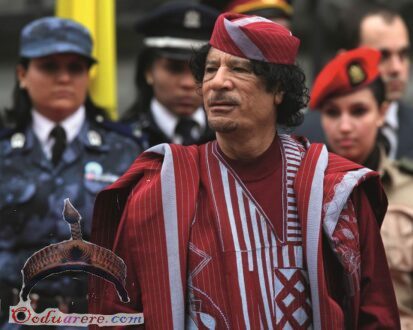
And here come the propaganda fairytales.
The “Viagra for mass rape” story was fabricated, fictional propaganda that stole plotlines from Nollywood scripts. But while that was fictional, the rape of Palestinians by Israelis is real. The mass genocide of the Palestinians is real. These ridiculous claims were heaped upon him because he chose to stand up to the West, colonialism, and the state of Israel.
Libya enjoyed social programs that even the most capitalistic American would dream of. They enjoyed free housing, healthcare, and education. After the death and public sodomization of Gaddafi, Libya has balkanized and denigrated into a non-state entity that sells slaves in broad daylight.
On Western Hypocrisy
Are they really brutes compared to the actual brutes, who are allies of the West, or are they semi-brutes who still have the interests of their country at heart? That is the 300 million dollar question.
Ugandan President Mobutu can loot Zaire for decades and still be treated as a “strategic ally.” The House of Saud can fund extremist ideology, crush dissent, and dismember journalists, yet it is still courted as a partner in “stability.” The difference between “our friend with flaws” and “mad dog of the Middle East” has never been morality. It has always been obedience.
With programs like Operation Mockingbird, the CIA maintained secret relationships with dozens of US journalists and hundreds of foreign media assets for intelligence collection and covert propaganda. The irony is that it’s propeganda operation is getting sloppier. The lies are getting lazier; for example, 40 beheaded babies; the scripts are more recycled, i.e., Iran has a nuclear weapon; and the plot holes are more visible. Thanks to the internet, people can cross-check official narratives with raw footage, leaks, and open-source investigations. Despite attempts to censor independent journalism and manipulate algorithms, the monopoly on information has broken.
There is real hope in that crack. Well, unless you are a boomer who only watches Fox News while sitting in front of the TV, eating a microwavable dinner, waiting for your kid to resume contact with you. Sorry, that was a bit personal.
The younger generations are not living in a one-channel universe. They are watching Gaza, Iran, Yemen, and Ukraine in real time. They can see which lives are stolen, they see the brutality of the empire, and they see those civilians who are viewed as “collateral damage.”
We Can’t Forget About the Jews… Well, Israelis!
Israel’s influence in controlling the narrative runs through all three cases, and it does not operate in isolation from British, American, and broader Western interests.
Idi Amin: British Made, Israel Trained
British Foreign Office papers show that the first telegrams from High Commissioner Richard Slater to London show a man shocked by the coup, who immediately turned to the man he thought might know what was going on: Colonel Bar-Lev, the Israeli defence attaché — who had spent the morning of the coup together with Amin. But were they surprised, though? Israel owes its existence to the British, but this article is already lengthy, so we won’t delve into that topic.
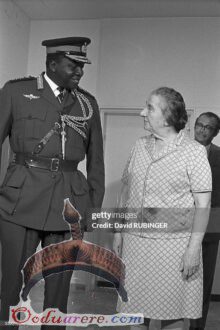
Idi Amin meets with Golda Meir during a visit to Israel.
In 1969, Israel began funneling weapons through Uganda into southern Sudan, where the Anyanya rebel group had been fighting the Arab-dominated Sudanese government since the nineteen-fifties. Idi Amin was the key Ugandan military contact for the Israelis in this operation and served as the go‑between for the Israelis and the South Sudanese rebel group. Declassified British post‑coup communications explain, “The main Israeli objective here is to ensure that the rebellion in southern Sudan keeps on simmering for as long as conditions require the exploitation of any weakness in the Arab world. They do not want the rebels to win. They want them to keep on fighting.”
Israel provided Amin with paratrooper training, strategic advice, and military hardware initially. But when Amin requested Phantom jet fighters for his planned invasion of Tanzania in 1972 (equipment requiring US approval), Israel refused, citing that the request “went beyond the requirements of legitimate self‑defense.”
This refusal triggered Amin’s March 1972 expulsion of Israeli military advisors and his pivot to Libya and Gaddafi for support.
The Entebbe Incident (1976)
When two members of the Popular Front for the Liberation of Palestine – External Operations (PFLP-EO) and two members of the German Revolutionary Cells landed an Air France plane at Entebbe, Uganda, Amin portrayed the role of negotiator. Israel suspected him of collaborating with the hijackers and launched Operation Entebbe, a dramatic rescue that cemented Amin’s status as an international villain. Because we all know that he who goes against “God’s chosen people” or fails to adhere strictly to their commands is made out to be the ultimate El Diablo.
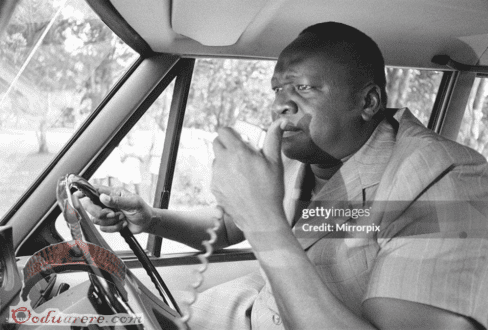
President Idi Amin at the wheel of his Range Rover at Entebbe Airport near Kampala, Uganda.
Idi Amin at the wheel of his Range Rover at Entebbe Airport
They even made two Hollywood films (Victory at Entebbe, 1976; Raid on Entebbe, 1977) that immediately established Israel’s version in popular memory: the brave Israeli commandos rescuing helpless hostages from a mad African dictator who was practically a terrorist himself. The films didn’t mention that Amin had initially allowed the Red Cross to visit the hostages or that the hijackers had separated Israeli and non‑Israeli passengers. The Hollywood version required a villain, and Amin, having already been on the bad side of the Israelis, was the perfect match.
This incident is also steeped in notoriety for another reason. Yonatan Netanyahu, the brother of the current genocidal maniacal president of Israel, Benjamin Netanyahu (fka Mileikowsky), was the sole fatality among the commandos killed in this incident.
This event initiated the beginning of Bibi’s political career and therefore became the foundation for his current villainous arc.
Sani Abacha: The Security Back-Channel
Abacha’s elite personal security detail, the Strike Force, coordinated by Major Hamza Al‑Mustapha, received training from Israeli security experts. Testimony from the post‑Abacha investigations and reports from Sgt. Barnabas Jabila (”Sgt. Rogers”), an Abacha henchman, confirmed Israeli involvement in training the unit under the guise of hunting “terrorists.”
The United States imposed targeted sanctions and embargoes on the regime of Abacha between 1993 and 1998 in response to human rights violations. To circumvent this embargo, Israeli‑provided arms and technology started flowing into Abacha’s government apparatus via backchannels. Iran‑Contra vibes, anyone.
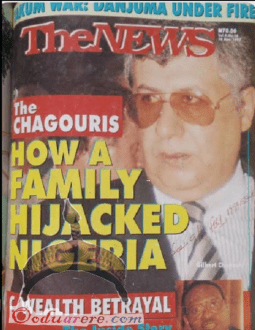
Enter the Lebanese‑Nigerian Zionist…
Gilbert Chagoury, Abacha’s Lebanese‑Nigerian billionaire “confidant,” acted as the bridge to Western, including Israeli, circles. Chagoury’s network extended into Israeli and American political and business circles, allowing “plausible deniability” for the Israeli government while private security firms staffed by former Mossad officers provided security and technological expertise.
So the Israelis had experimental access to both Abacha’s security and surveillance tech, and he just happened to die a mysterious death with no autopsy in sight.
(Insert fake gasp and color me surprised.)
Muammar Gaddafi: Israel’s Arch-Nemesis
Gaddafi’s relationship with Israel is the most public and prolific of the three, and it is where his foreign policy, his support for Palestinian resistance, and his economic ambitions collided most directly with Western and Israeli red lines.
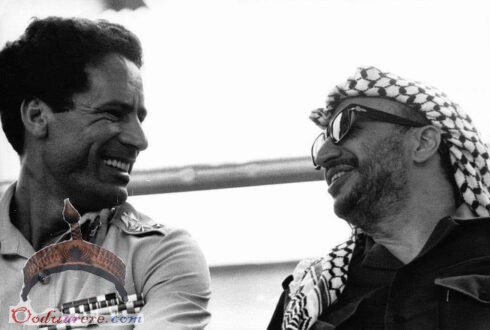
Muammar Gaddafi and Yasser Arafat in Kampala
Gaddafi was Israel’s most vocal Arab enemy. He funded the Black September Organization, a Palestinian resistance group, viewed Israel as a “cancer” and a “poisoned dagger” in the Arab world, and refused to recognize it as a state. He called Israel a “fascist state,” broke with Arafat for being “too moderate,” and offered $10 million to blow up an El Al plane after Israel shot down Libyan Arab Airlines Flight 114 in 1973, killing 108 people. In later years, he proposed a one-state solution called “Isratin” (Israel-Palestine) to dissolve the Jewish state framework.
These are just the tip of the iceberg of the hostile stance Gaddafi took against Israel.
Sadly, we all know how undignified his end was, and we can definitely attribute this violent death to his anti‑Western and anti‑Israel stance.
All that to say
This selective conscience is a pattern, not an accident. In today’s terms, we see examples of this in the form of the West being worried about the Christians in Nigeria but ignoring the death of Muslims at the hands of the US‑sponsored terror group Boko Haram; they are worried about the women of Iran but continue to bomb the country indiscriminately, killing women and children. The West’s self‑righteousness even fails to protect its own citizens, as seen in the arrests of Britons for pro‑Palestine posts and Americans shot for opposing Trump’s violent immigration policies.
The West called Abacha a “kleptocrat” while taking his money through Treasury bonds. It’s not just Western powers creating caricatures of African monsters; it’s a network of aligned interests (US, UK, Israel) where the “despot” label is applied selectively based on who relegates the wealth and the sovereignty of their country to the hands of the West.
The “despot” label isn’t about morality; it’s about control. When the West and Israel control the relationship, the leader is “complex.” When the leader acts independently, they become a “kleptocratic madman.”
African sovereignty means refusing that script. It means claiming the right to tell our own stories about our own monsters, and to decide for ourselves which of them were merely thieves, which were patriots gone wrong, and which were threats not because they were evil, but because they dared to say no.